01
The Power of Small Daily Habits
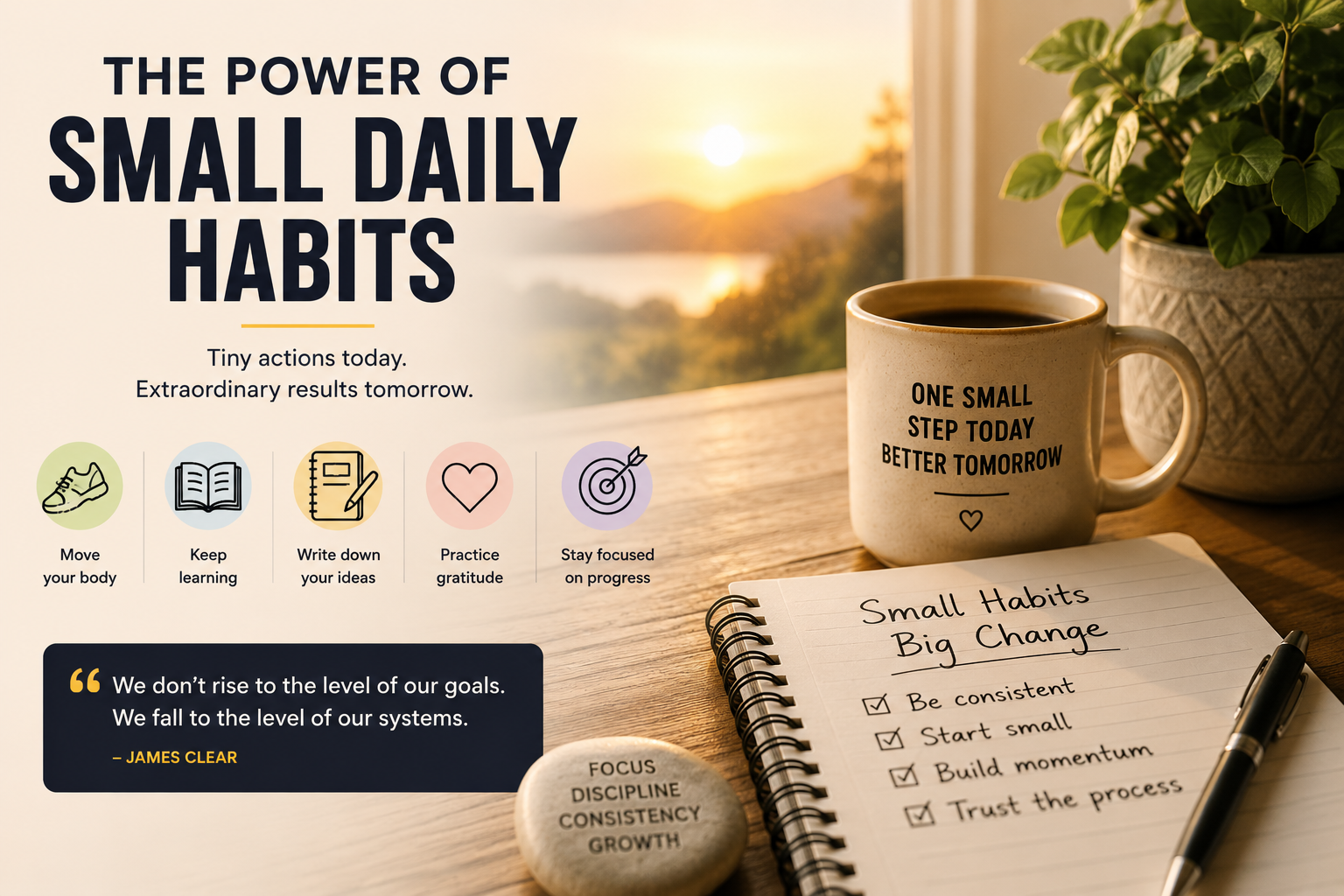
When people think about transformation, they often imagine dramatic changes - a new career, a major breakthrough, or a life-changing decision. In reality, many of the most meaningful improvements begin with something much smaller: a simple daily habit.
A habit may seem insignificant in the moment. A ten-minute walk. Reading a few pages before bed. Writing down a single idea. Practicing gratitude for a minute each morning. None of these actions feels life-changing on its own. Yet when repeated consistently, they compound over time in remarkable ways.
Small habits work because they reduce resistance. They don't require perfect motivation or extraordinary discipline. Instead, they become part of a routine. Over weeks, months, and years, those small actions begin to shape our health, relationships, skills, and outlook on life.
The beauty of daily habits is that they focus on progress rather than perfection. Missing a day isn't failure. The goal isn't flawless execution - it's consistency. A small step taken repeatedly is often more powerful than a giant leap taken once.
Many successful people attribute their accomplishments not to extraordinary talent, but to ordinary actions repeated over time. Whether you're learning a new skill, improving your health, or pursuing a personal goal, lasting change often starts with a habit so small it feels almost insignificant.
Never underestimate the power of doing something positive today, even if it's only for a few minutes. Small habits have a way of becoming extraordinary results.
02
Why Meaningful Progress Matters More Than Perfection
Perfection is an appealing idea. We imagine the perfect plan, the perfect timing, or the perfect result. Yet perfection often creates a hidden problem, it convinces us to wait.
We wait until we're more prepared. More skilled. More confident. More certain. In the process, opportunities pass us by.
Meaningful progress works differently. Progress acknowledges that growth happens through action, experimentation, and learning. It recognizes that mistakes are not evidence of failure - they are evidence that we're moving forward.
Most accomplishments are built through a series of imperfect steps. Writers create rough drafts. Entrepreneurs launch unfinished ideas. Athletes improve through countless small adjustments. Progress isn't glamorous, but it is effective.
The pursuit of perfection can create unnecessary pressure. It encourages us to focus on flaws rather than achievements. Progress, on the other hand, encourages momentum. It shifts our attention from what is missing to what is improving.
Every meaningful journey begins before the path is fully clear. The people we admire most rarely started with perfect circumstances. They simply took the next step available to them and continued moving forward.
At the end of the day, perfection is an illusion. Progress is real. And real progress, no matter how small, has the power to change our lives.
03
Finding Beauty in Ordinary Moments
It's easy to believe that extraordinary experiences are what make life meaningful. A dream vacation. A major achievement. A milestone celebration.
Yet many of our happiest memories come from moments that seemed ordinary at the time.
A conversation with a friend. Sunlight through a window. A quiet morning with a cup of coffee. The sound of laughter from another room. These small experiences often carry a depth and significance we only recognize later.
Modern life encourages us to chase bigger, faster, and more exciting experiences. But beauty is not reserved for special occasions. It exists all around us - in routines, relationships, and everyday moments we might otherwise overlook.
Learning to notice these moments can change the way we experience life. It encourages gratitude, presence, and appreciation. Instead of constantly looking ahead, we become more aware of what's happening right now.
The ordinary is where most of life takes place. And when we slow down long enough to pay attention, we often discover that the ordinary is anything but ordinary.
Sometimes the most meaningful moments are the ones we never planned for at all.
04
Lessons We Can Learn From Nature
Nature has been solving problems for millions of years.
From the resilience of a tree weathering countless storms to the efficiency of a honeybee colony, the natural world offers lessons that extend far beyond science. It reminds us that growth often takes time, adaptation is essential, and strength can take many forms.
One of nature's most powerful lessons is patience. Trees don't rush to grow. Rivers don't force their way to the ocean. Seasons change in their own time. Yet despite their gradual pace, they create extraordinary results.
Nature also teaches resilience. Forests recover after wildfires. Plants emerge through cracks in concrete. Life continually finds ways to adapt and move forward despite challenges.
Perhaps most importantly, nature reminds us that change is a natural part of existence. Every season serves a purpose. Growth and rest, expansion and renewal all play a role in the larger cycle.
In a world that often feels rushed and unpredictable, spending time in nature can help us reconnect with timeless truths. Sometimes the best advice doesn't come from a book or a screen - it comes from simply paying attention to the world around us.
05
The Surprising Benefits of Slowing Down
Modern culture often celebrates speed. Faster results. Faster decisions. Faster growth.
But moving quickly isn't always the same as moving effectively.
When we slow down, we create space to think more clearly, notice more deeply, and make better decisions. We become less reactive and more intentional. Instead of rushing through experiences, we begin to engage with them fully.
Slowing down doesn't mean becoming unproductive. In many cases, it leads to greater focus and efficiency. By reducing distractions and giving our attention to what matters most, we often accomplish more with less stress.
Some of life's most meaningful moments happen when we're not rushing. A walk through a park. A conversation without checking our phones. A quiet moment of reflection. These experiences may seem small, but they often have a lasting impact.
The world will always move quickly. The challenge is learning when to match its pace and when to step back. Sometimes slowing down is exactly what allows us to move forward.
06
How Gratitude Changes the Way We See the World
Gratitude has a remarkable ability to shift our perspective.
It doesn't require us to ignore challenges or pretend life is perfect. Instead, it encourages us to recognize what is already good, meaningful, and valuable in our lives.
When we focus exclusively on what we lack, it's easy to feel dissatisfied. Gratitude helps balance that perspective by drawing attention to what we already have - relationships, opportunities, experiences, and simple everyday comforts.
Research has consistently linked gratitude to greater well-being, stronger relationships, and improved resilience. But perhaps its greatest benefit is how it changes our mindset. It trains us to notice positives that might otherwise go unnoticed.
Gratitude doesn't have to be complicated. It can be as simple as appreciating a beautiful sunset, a kind gesture, or a moment of peace in a busy day.
The more we practice gratitude, the more we begin to see the world through a different lens - one that recognizes abundance where we once saw scarcity.
07
People Who Changed the World One Step at a Time
History often remembers great achievements, but it rarely shows the countless small steps that came before them.
Behind every major breakthrough, movement, or innovation is a story of persistence. The people who change the world rarely do so overnight. More often, they make progress one decision, one effort, and one day at a time.
Inventors spend years refining ideas. Leaders overcome repeated setbacks. Artists create countless drafts before producing their best work. What appears to be sudden success is usually the result of sustained effort over time.
This perspective is encouraging because it reminds us that meaningful impact doesn't require instant greatness. It begins with action. A single step may not seem significant, but many small steps taken consistently can lead to extraordinary outcomes.
Every accomplishment starts somewhere. The next time a goal feels overwhelming, remember that even the most remarkable journeys begin with a single decision to move forward.
08
Why Hope Is More Powerful Than We Realize
Hope is often misunderstood as wishful thinking. In reality, hope is one of the most powerful forces that drives human action.
Hope gives people a reason to keep trying when circumstances are difficult. It allows us to imagine a better future and motivates us to take steps toward it.
Throughout history, hope has helped individuals, communities, and entire societies overcome tremendous challenges. It creates resilience by reminding us that today's situation is not necessarily tomorrow's reality.
Hope doesn't require certainty. In fact, hope is most valuable when outcomes are uncertain. It exists in the space between where we are and where we want to be.
When combined with action, hope becomes a powerful catalyst for change. It fuels perseverance, encourages optimism, and helps us continue moving forward even when progress feels slow.
The future is rarely guaranteed. Hope is what gives us the courage to keep building it anyway.
09
The Art of Starting Before You're Ready
Many people spend years waiting for the perfect moment to begin.
They wait until they have more experience, more confidence, more knowledge, or more certainty. Unfortunately, that perfect moment rarely arrives.
The truth is that most meaningful pursuits begin before we feel completely prepared. Entrepreneurs launch businesses without knowing every answer. Writers start with blank pages. Travelers visit unfamiliar places. Every new endeavor involves a degree of uncertainty.
Starting before you're ready doesn't mean being reckless. It means accepting that growth often happens during the journey rather than before it.
Confidence is not usually the cause of action. More often, confidence is the result of action. As we take small steps, we gain experience, learn from mistakes, and discover capabilities we didn't know we possessed.
The biggest obstacle to beginning is often the belief that we must be fully prepared first. In reality, progress belongs to those who are willing to start while still learning.
The first step may not be perfect, but it is almost always better than standing still.
10
What It Means to Live a Curious Life
Curiosity is one of the most valuable qualities a person can cultivate.
It encourages us to ask questions, explore new ideas, and remain open to experiences outside our comfort zone. Curious people see the world not as something they already understand, but as something they are continually discovering.
Living a curious life doesn't require traveling the world or pursuing extraordinary adventures. It can be as simple as learning a new skill, reading about an unfamiliar subject, or having a conversation with someone whose perspective differs from your own.
Curiosity keeps life interesting because it transforms ordinary experiences into opportunities for discovery. It helps us remain adaptable, creative, and engaged with the world around us.
Perhaps most importantly, curiosity reminds us that growth never truly ends. There is always something new to learn, understand, or appreciate.
A curious life is not defined by having all the answers. It is defined by continuing to ask meaningful questions and remaining excited about what you might discover next.