01
Where Great Ideas Begin
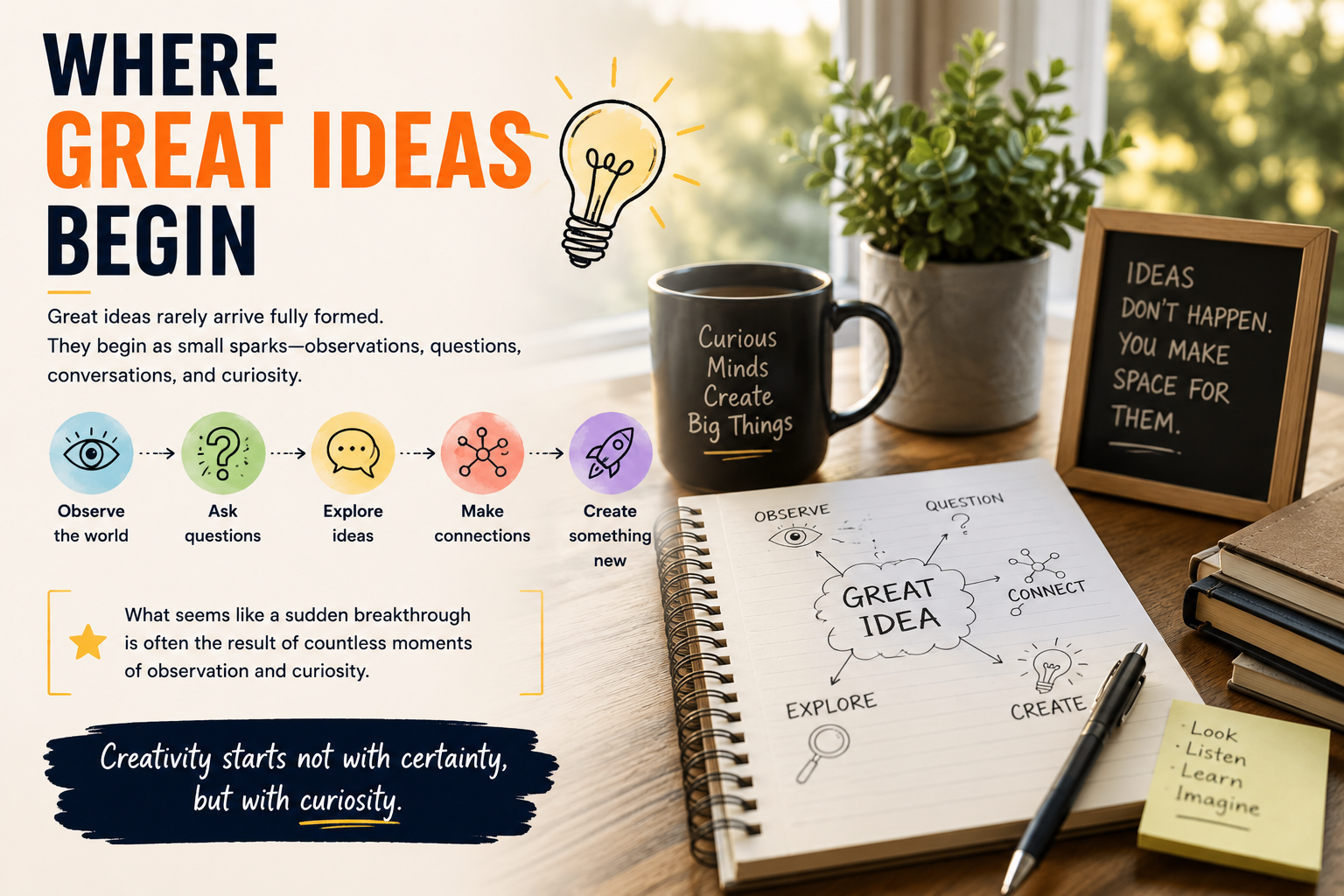
Great ideas rarely arrive fully formed.
More often, they begin as fragments - an observation, a question, a conversation, or a moment of curiosity. What eventually becomes a breakthrough usually starts as a small spark that grows through exploration and refinement.
Creative people understand that ideas need room to develop. They collect inspiration, experiment freely, and allow connections to form between seemingly unrelated concepts. What appears to be sudden brilliance is often the result of countless moments of observation and curiosity.
The origin of a great idea is rarely dramatic. It often begins with paying attention to the world around us and asking questions others might overlook.
Creativity starts not with certainty, but with curiosity.
02
Why Creativity Thrives Within Constraints
Many people assume creativity requires unlimited freedom. Surprisingly, the opposite is often true.
Constraints force us to think differently. Limited resources, deadlines, budgets, and boundaries challenge us to find new solutions and unexpected approaches. Instead of restricting creativity, constraints often focus it.
Some of history's most innovative designs, works of art, and inventions emerged because creators had to work within specific limitations. The challenge itself became part of the creative process.
When everything is possible, it's difficult to know where to begin. Constraints provide direction. They encourage experimentation and help transform ideas into reality.
Sometimes creativity flourishes not because of freedom, but because of the boundaries that shape it.
03
The Art of Seeing Things Differently
Creativity often begins with perspective.
Two people can look at the same object, situation, or problem and see entirely different possibilities. Creative thinkers develop the ability to notice patterns, opportunities, and connections that others may miss.
This skill isn't limited to artists or designers. It can be cultivated by anyone willing to stay curious and challenge assumptions. Asking new questions, exploring unfamiliar subjects, and embracing diverse experiences all help expand perspective.
Innovation frequently comes from seeing familiar things in unfamiliar ways. What separates ordinary thinking from creative thinking is often not intelligence, but observation.
The world is full of possibilities waiting to be seen differently.
04
How Creative Spaces Shape Creative Thinking
Our surroundings influence how we think.
The spaces where we work, create, and reflect can either encourage imagination or limit it. Natural light, inspiring visuals, open environments, and thoughtfully designed workspaces often help foster creativity and focus.
Creative spaces don't need to be elaborate. Sometimes a simple desk by a window, a favorite coffee shop, or a quiet corner of a room can become a place where ideas flourish.
What matters most is creating an environment that encourages curiosity, experimentation, and concentration. The right space can make it easier to explore ideas and bring them to life.
Creativity isn't only about what happens in our minds. It's also influenced by the environments we choose to inhabit.
05
The Power of Play in the Creative Process
Play is often associated with childhood, but it remains one of the most powerful tools for creativity throughout life.
When we play, we experiment without fear of failure. We become more willing to take risks, explore possibilities, and follow unexpected paths. This openness creates fertile ground for new ideas.
Many creative breakthroughs emerge from moments of exploration rather than structured planning. Artists sketch without a specific goal. Inventors tinker with prototypes. Writers brainstorm possibilities before settling on a final direction.
Play encourages discovery. It reminds us that creativity is not always about producing results. Sometimes it's about exploring what might be possible.
The willingness to play may be one of the most underrated creative skills of all.
06
Inspiration Is Everywhere If You Know Where to Look
Inspiration rarely arrives on demand.
More often, it appears when we expose ourselves to new experiences, ideas, and perspectives. A conversation, a book, a walk through a city, or a moment in nature can all become sources of creative energy.
Creative people often develop habits of observation. They pay attention to details others overlook. They remain open to influence from unexpected places and constantly gather ideas from the world around them.
The challenge isn't finding inspiration. The challenge is noticing it.
Once we learn to observe more carefully, inspiration begins to appear almost everywhere we look.
07
Why Every Creative Master Started as a Beginner
Every accomplished artist, designer, musician, writer, and creator began at the same place: the beginning.
It's easy to admire finished work and forget the years of practice, mistakes, and experimentation that came before it. Mastery is rarely the result of natural talent alone. It is built through repetition, learning, and persistence.
The beginner's stage can feel uncomfortable because progress is slow and uncertainty is high. Yet it is also where growth happens. Every expert was once inexperienced. Every masterpiece started as a rough draft.
The path to creativity is not about avoiding mistakes. It's about continuing despite them.
Every creator's journey begins with the courage to start.
08
The Most Creative Cities in the World
Certain cities seem to generate creativity naturally.
They attract artists, entrepreneurs, designers, musicians, and innovators who contribute to a culture of experimentation and expression. These places become centers of inspiration because they encourage diversity of thought and experience.
Creative cities often share common characteristics: vibrant communities, public art, cultural institutions, walkable neighborhoods, and opportunities for collaboration.
While creativity can happen anywhere, some environments make it easier for ideas to collide and evolve. The energy of a creative city often comes from the people who continually challenge conventions and imagine new possibilities.
Creativity thrives where imagination is welcomed.
09
Building a Life Around Curiosity and Creation
A creative life is not defined by a profession. It is defined by a mindset.
People who live creatively remain curious. They seek new experiences, pursue interests, ask questions, and make time for exploration. They understand that creativity extends beyond art and can be applied to problem-solving, relationships, careers, and everyday living.
Living creatively means participating in the world rather than simply observing it. It means making, experimenting, learning, and growing.
The goal is not perfection. The goal is engagement.
A life built around curiosity and creation is often one filled with meaning, discovery, and possibility.
10
The Courage to Create Something New
Every act of creation involves vulnerability.
Whenever we share an idea, start a project, or create something original, we face uncertainty. There is no guarantee of success. There is always the possibility of criticism or failure.
Yet creativity depends on the willingness to move forward despite those risks.
The world's most influential creators were not fearless. They simply chose to create anyway. They understood that innovation requires experimentation and that meaningful work often begins before outcomes are certain.
Creating something new is an act of optimism. It reflects a belief that our ideas, efforts, and imagination can contribute something valuable to the world.
The courage to create may be one of the most powerful forms of courage there is.